Openers · Toronto
Chain-Drive Opener Repair
The rail shakes when the door runs.
In plain words
Cold is hard on a chain drive, and a detached or unheated garage shows it first. Grease on the rail and inside the gearbox thickens, a chain with surface rust stiffens link by link, and the operator strains against a door whose bottom seal may also be frozen to the slab. The result is a door that groans, stalls or reverses on the coldest mornings and works by afternoon. The repair frees or replaces a rusted chain, cleans and regreases the rail and gears, and sets force so the operator moves the door in the cold without being pushed past its safety limit.
How the visit goesThe door opens about a third of the way and stops. Turning the limit screw on the head has made no difference, and the trolley seems to sit in the wrong place along the rail when the door is fully closed.
Chain-Drive Opener Repair
How the visit goes
Reading the chain itself
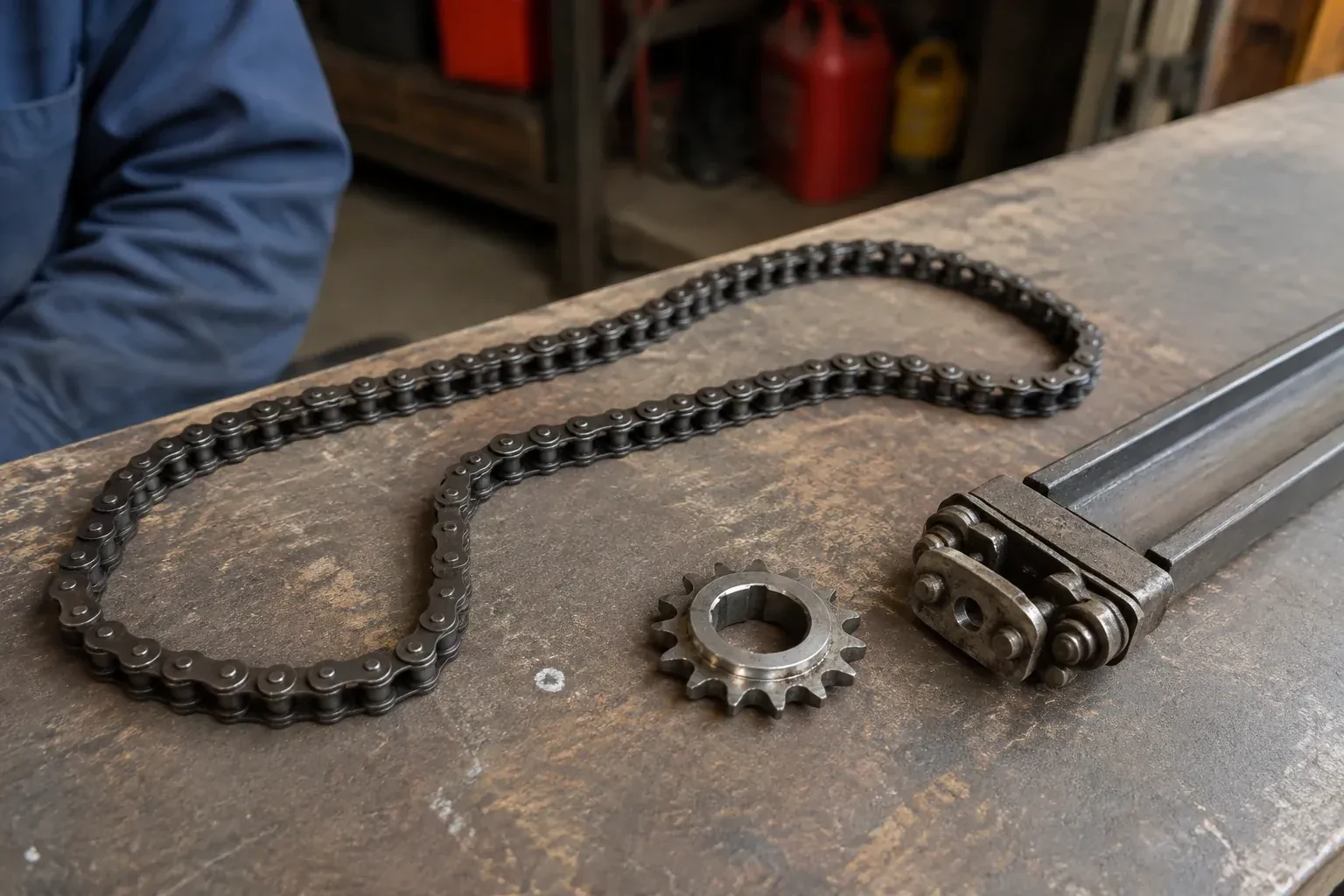
A chain tells its age. The technician runs it through their fingers with the door disconnected, feeling for stiff or seized links, surface rust that has crept into the rollers, and a master link that has spread. Stretch shows as sag: with the door closed, the chain is measured at the middle of the rail against the maker's figure for that make and rail shape, since the correct height is not the same across models. A chain that sits well below that figure after years of use has lengthened and may need replacing rather than tensioning, because taking up too much slack at the trolley leaves the run over the sprocket uneven.
Resetting travel and force
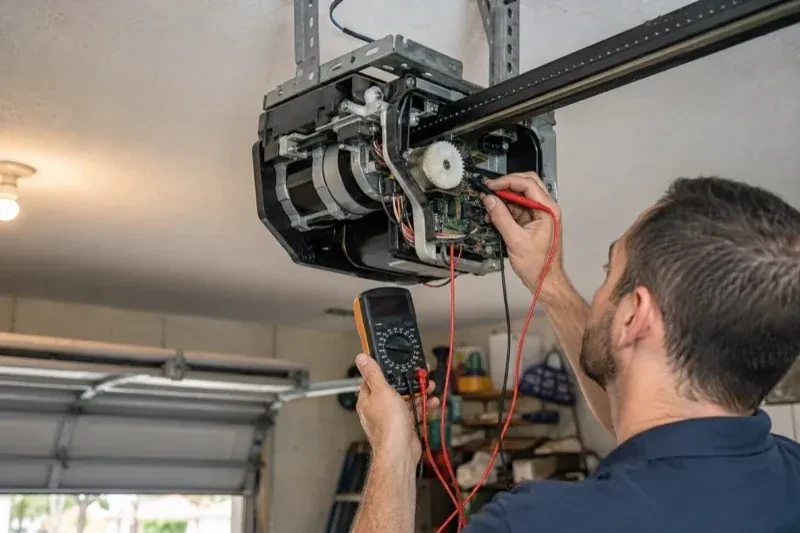
With the drive mechanically sound, the operator is taught the door again. On older heads, the up and down limit screws are turned with a flat screwdriver, each full turn moving the stop about 5 cm, until the door meets the floor with the seal lightly compressed and opens to full height without the trolley reaching the bolt. Force is set to the lightest level that moves the door reliably through a full cycle in the garage's normal temperature. Newer heads run a learn cycle from buttons on the back and measure both for themselves. The operator is then cycled several times to confirm the settings hold.
A drive that runs true again
What you have afterwards is a chain that sits at its measured height, rides the sprocket without skipping and carries the trolley the full length of a rail that no longer moves. The door starts and stops where it should, meets the floor without bouncing back and opens to its full height. The sound settles to the steady run a chain drive is meant to have, with the slap, clack or grinding gone. The technician shows you the replaced parts so you can see what wore out, and runs the door for you a few times so you know what normal now sounds and looks like.
Chain-Drive Opener Repair
In the van
Idler sprocket or pulley
RPM sensor
Trolley release lever
Inner and outer trolley
Drive gear and worm gear kit
Chain-Drive Opener Repair
What affects the quote
Ceiling height and access
A head hung from a high or cathedral ceiling, or a rail boxed in by storage racks, a lift or ductwork, takes longer to reach and work on than one under a standard joist with a clear floor.
What is known before the visit
A model number and photographs of the head, rail and chain let the technician arrive with the right gear kit or chain, which keeps the job to one visit rather than two.
Trolley and release parts
A worn inner or outer trolley, a cracked latch or a bent release lever are replaced as separate pieces, and whether any of them is needed shows only once the trolley has been run along the rail by hand.
What to have ready
- Is the chain hanging loose under the rail, or is it rusty or stiff?
- Does the motor run when you press the button, and does the door move at all?
- Do the photo-eye sensors near the floor show steady lights?
Chain-Drive Opener Repair: questions
QuestionsThe door is stuck. Should I pull the red cord?
Yes, if you need the door open and the door is closed or nearly so. Pulling the handle frees the door from the trolley so it can be lifted by hand. Do not pull it while the door is open, because a door with a weak spring can drop. If the door will not lift by hand, or feels very heavy, leave it and mention that when you call, since it points to a spring rather than the drive.
My opener is decades old. Can the chain drive still be repaired?
Often, yes. Gear kits, sprockets, chains and trolleys are still made for many older heads, and tension, phase and limits can be set on almost any unit. The limit is parts: some makers no longer support units made before the mid-1990s, and those also lack the photo-eye protection expected today. The technician checks parts availability for your model and lays out repair beside renewal so you can decide with the facts.
Why does the door touch the floor and then go back up?
The operator believes it has hit something. Either the down travel limit is set a little too far, so the door is pressing into the floor past its stopping point, or the closing force is set too low for the door's current weight, so the last push reads as an obstruction. A seal frozen to the slab causes the same reversal in winter. The technician adjusts the limit or the force, in that order, and re-tests the reversal afterwards.
Related services
- Belt-Drive Opener RepairThe belt looks fine from a distance, but up close the rubber has cracked across the back in dozens of places and, in one spot, you can see the steel cords showing through.
- Garage Door Opener ReplacementDuring the ice storm the power was off for two days.
- Photo-Eye Sensor Alignment or ReplacementSomeone backed the car in a little too far, a bin or a bicycle brushed the track, and since then the door starts to close and comes back up.