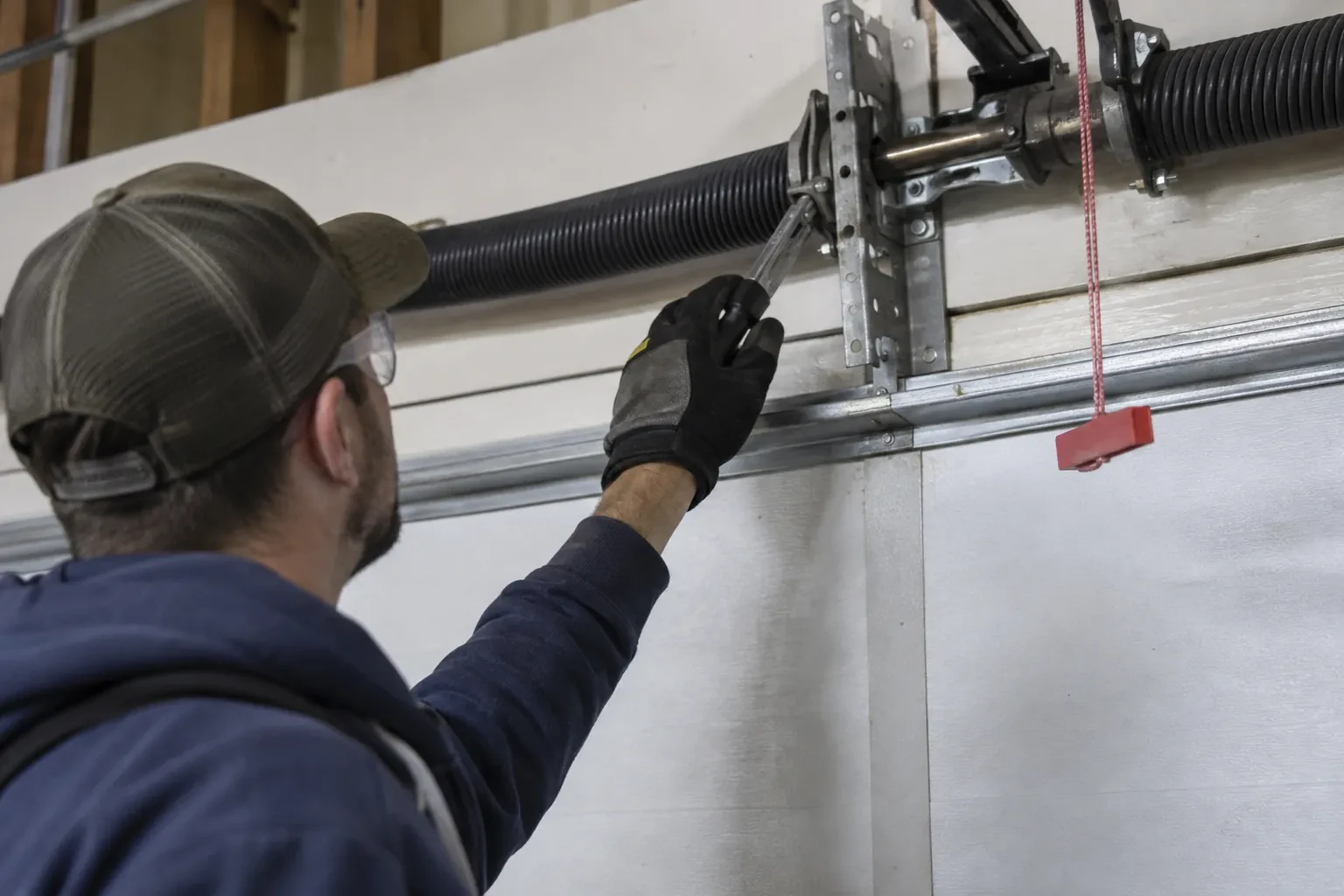
Garage Doors
Owner's notes
New to owning a garage door, or new to this one? These guides walk through what the parts are called, how the door should behave, and what a healthy door sounds like.
Have a question?
Will you tell me if the door should not be used?
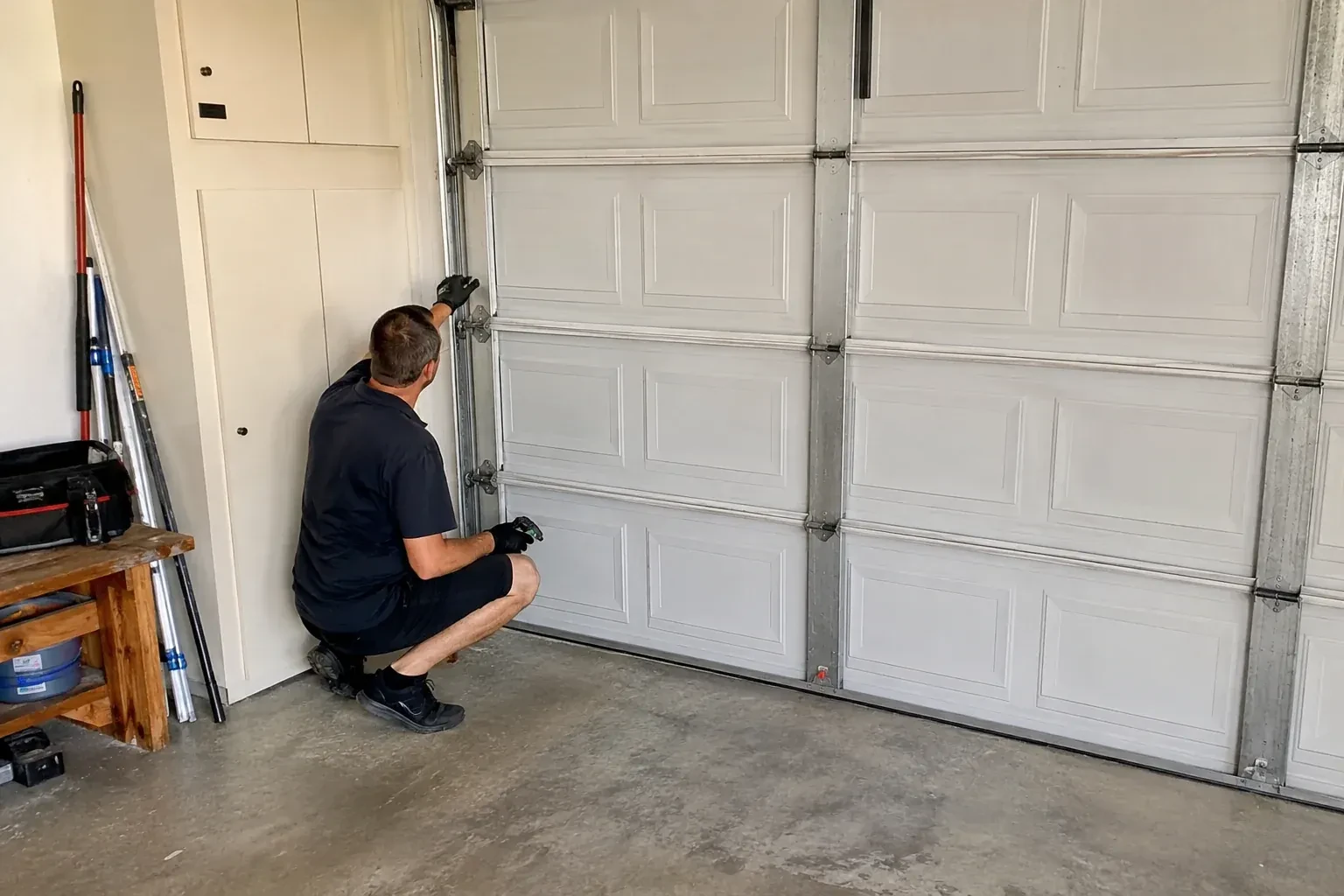
Yes, plainly and at the door. A slack or frayed cable, a gap in a spring coil, a door hanging crooked, a bracket pulling out of the framing or an opener that fails the reversal test are the kinds of findings that put an item in the stop-use group. When that happens you see the reason yourself, the door is left resting in a safe spot with the opener unhooked, and the fix is written up and quoted so it can be booked.
Why does my door struggle in cold weather?
Cold affects several things at once. Old lubricant thickens into a drag on every hinge and bearing. Steel contracts slightly, so a track that was snug becomes tight. Rubber seals stiffen and the bottom seal can freeze to the slab. The opener then reads all this extra resistance as an obstruction and stops or reverses. A fall tune-up with a low-temperature lubricant, silicone on the seals and correctly set force goes a long way toward smooth winter mornings.
What information helps when I call?
Say how the door is sitting: fully open, part way, or closed and crooked. Mention whether a cable is hanging loose, whether anything hit the door, whether it was frozen to the floor, and whether a vehicle is inside. The door's width and whether it has springs above the opening or along the tracks helps too. This tells the technician what hardware to bring so the reset finishes in one visit.
Can a dent be repaired instead of replacing the section?
Sometimes. A shallow dent in the middle of a steel skin, away from joints and hinge points, can often be eased out or filled, sanded and painted. Damage that creases the metal, reaches a joint or an end stile, bends a hinge point, or kinks a strut affects how the section carries load as the door moves, and a new section is the sound repair there. The technician tells you which category your dent falls into.
The seal looks fine, so why is there still daylight under the door?
A seal can look intact and still have taken a permanent set, so the bulb no longer springs up to fill the gap. Otherwise the gap belongs to something else: a door hanging out of level, a bowed bottom section, a floor that has settled at one end, or an opener down limit set so the door stops short. The first look during the visit sorts these apart so the fix goes to the right place.
What should I do before the technician arrives?
Move the car out of the garage or well back from the door, and clear anything stored against the jambs inside and any bins, planters or snow piled against them outside. Leave the door closed so the gaps can be seen as they are. If you have noticed where the daylight, drafts or snow come in, or where the mice appear, be ready to point it out.
Can a bent lock bar be straightened?
It is better replaced. Lock bars are spring steel, and once one has been bent by an opener pulling against it, it takes a set and tends to bind in its guide or kink again under load. New bar stock is cut to the door's width so the bar reaches through the track with a margin and pulls fully back when released. Both bars are set to the same throw.
Will new rollers make my door quieter?
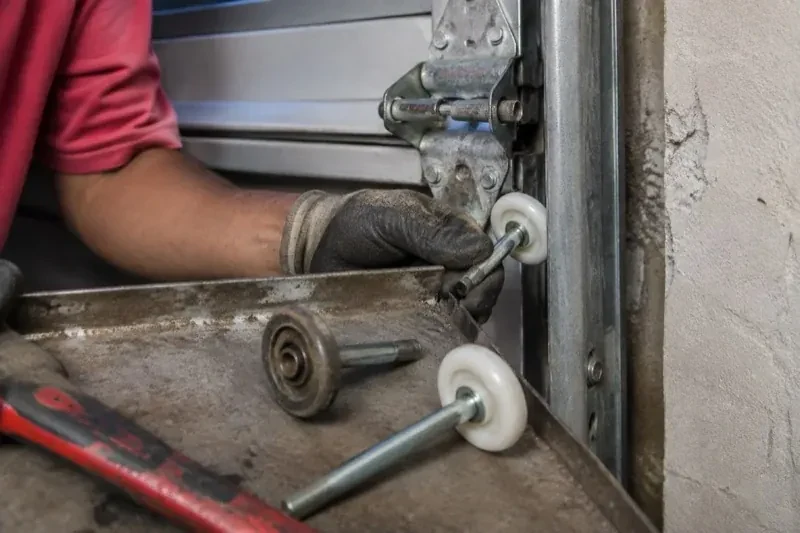
Usually, and often dramatically. Rollers are the only part of the door that touches the track, so most of a door's clatter starts there. Moving from worn steel or bare plastic wheels to nylon ball-bearing rollers changes the sound more than any other single part. The rest of the quiet comes from the same visit: hinges lubricated, loose bolts tightened, the track squared so nothing rubs. Springs can still squeak on their own, and the technician can treat those separately.
Why do the lowest hinges rust before the others?
They live where the water is. Slush and road salt drip off the car onto the bottom two joints and pool along the floor, and the salt attacks the zinc coating where the hinge leaf meets the pin and around the screw heads. Higher hinges stay dry and often look new when the low ones are brown. Wiping the low hardware after a thaw and a light silicone film in autumn slow it down.
Why is there a gap between the track and the edge of the door?
That gap is intentional. The rollers sit on stems that reach out from the hinges, and the track stands a set distance from the door so the wheels ride in the channel without the door's edge touching the track. The gap should be equal on both sides and slightly larger at the top of the vertical run, which is the taper that lets the door seal at the stop and release on opening. Unequal gaps are a sign the track has moved.
Can a cable be too long or too short for the door?
Yes, and both cause trouble. A cable that is too long runs out of drum groove and starts a second layer over the first, which wears it and throws the balance off near the top of travel. A cable that is too short leaves the door hanging out of level or the drum without a secure wrap. The correct length comes from the door height, the drum and the lift type, so the technician measures rather than guesses.
Does the opener need adjusting after the spring is replaced?
Usually a little. A balanced door presents a much lighter load than a door with a broken spring, so the opener's force settings are reset to suit it, and the travel limits are checked so the door seals at the floor and stops cleanly at the top. The technician then runs the reversal test and the photo-eye check to confirm the safety system responds correctly with the new balance.
Can I keep using the opener until the spring is replaced?
It is better to leave the door where it is. With one spring gone, the opener is lifting most of the door's weight on its own, which strains the motor, can bend the top section and often throws a cable off its pulley, adding to the work. Use another door in and out, keep the bay clear, and let the technician move the door once it is secured.
Will I need new springs, or just an adjustment?
The inspection decides, and looks past appearance alone. A spring can look sound, with tight, evenly spaced coils, no rust pitting and no gap, and still be the wrong specification for the door or nearing the end of its service life. The technician checks the spring's specification against the door's weight and history: a spring that checks out is wound and left in service, while one that is undersized, stretched, corroded or close to its cycle life is better replaced. Either path ends in a balanced door.
What do the blinking lights on the opener mean?
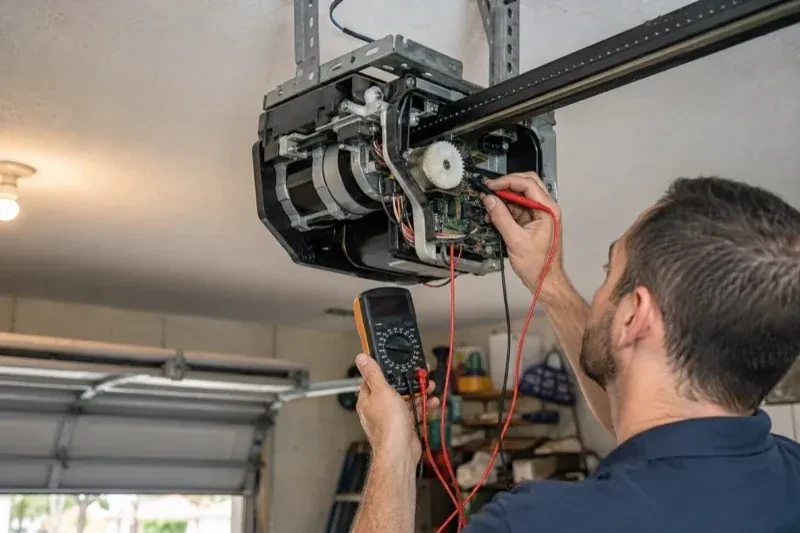
They are a diagnostic code. On openers made in roughly the past fifteen years, the head unit flashes its lights, or a pair of up and down arrows, in a counted pattern such as one flash then five. Each pattern corresponds to a fault family on the maker's chart for that model: sensor circuit obstructed or open, motor commanded but not moving, more force than allowed. The technician reads the pattern, then confirms it by hand, since one fault can imitate another.
The door is stuck. Should I pull the red cord?
Yes, if you need the door open and the door is closed or nearly so. Pulling the handle frees the door from the trolley so it can be lifted by hand. Do not pull it while the door is open, because a door with a weak spring can drop. If the door will not lift by hand, or feels very heavy, leave it and mention that when you call, since it points to a spring rather than the drive.
What information helps when I book a belt-drive repair?
The make and model printed on the motor head, roughly how old the operator is, what the belt is doing and what it sounds like, when it started, whether the red cord has been pulled and whether anyone has adjusted anything. A photograph along the rail showing the belt, and one of the label, settle most questions before the visit.
Can the new opener use my old rail?
The rail, trolley and drive are designed as one system with the head unit, so a new operator comes with its own rail matched to its motor and drive type. Reusing an old rail would mix parts that were never meant to run together. The old rail, head and hangers come down and are recycled, and a fresh rail is assembled to suit your door's height.
My opener has no sensors at all. Can they be added?
If the opener predates the entrapment-protection standard, which operators have had to meet since the mid-1990s, its board has no sensor circuit and a pair cannot simply be wired in. The positive news is that a modern operator brings the whole package: matched sensors, force reversal and a monitored circuit. The technician confirms the model first, because some units do have the terminals and simply had their sensors removed.
How is the keypad code chosen and can I change it later?
You choose it at programming time: four digits on many keypads, three to eight on others. Avoid the house number, a birth year or a repeated digit. The code is entered into the keypad, confirmed at the opener, and kept off the paperwork. Changing it later follows the instructions for your model and takes a couple of minutes, and the technician can show you the sequence before leaving.
Can one controller handle two garage doors?
Many hubs support two doors from one unit, each with its own door sensor, and each door appears separately in the app with its own name, status and history. Openers with built-in radios register individually, so a two-door garage with two connected openers simply shows two doors under one account. The technician confirms which arrangement your hardware supports before the visit.
Why should the door be closed before I pull the handle?
Because once the trolley lets go, the door is held only by its springs. A well-balanced door will stay put wherever it is, but a door whose springs are tired can drop, and one that is over-tensioned can rise on its own. Even with the door already on the floor it can still move unexpectedly, so keep the opening clear whenever the release is pulled. The industry checklist and opener makers give the same instruction: disconnect with the door fully closed.
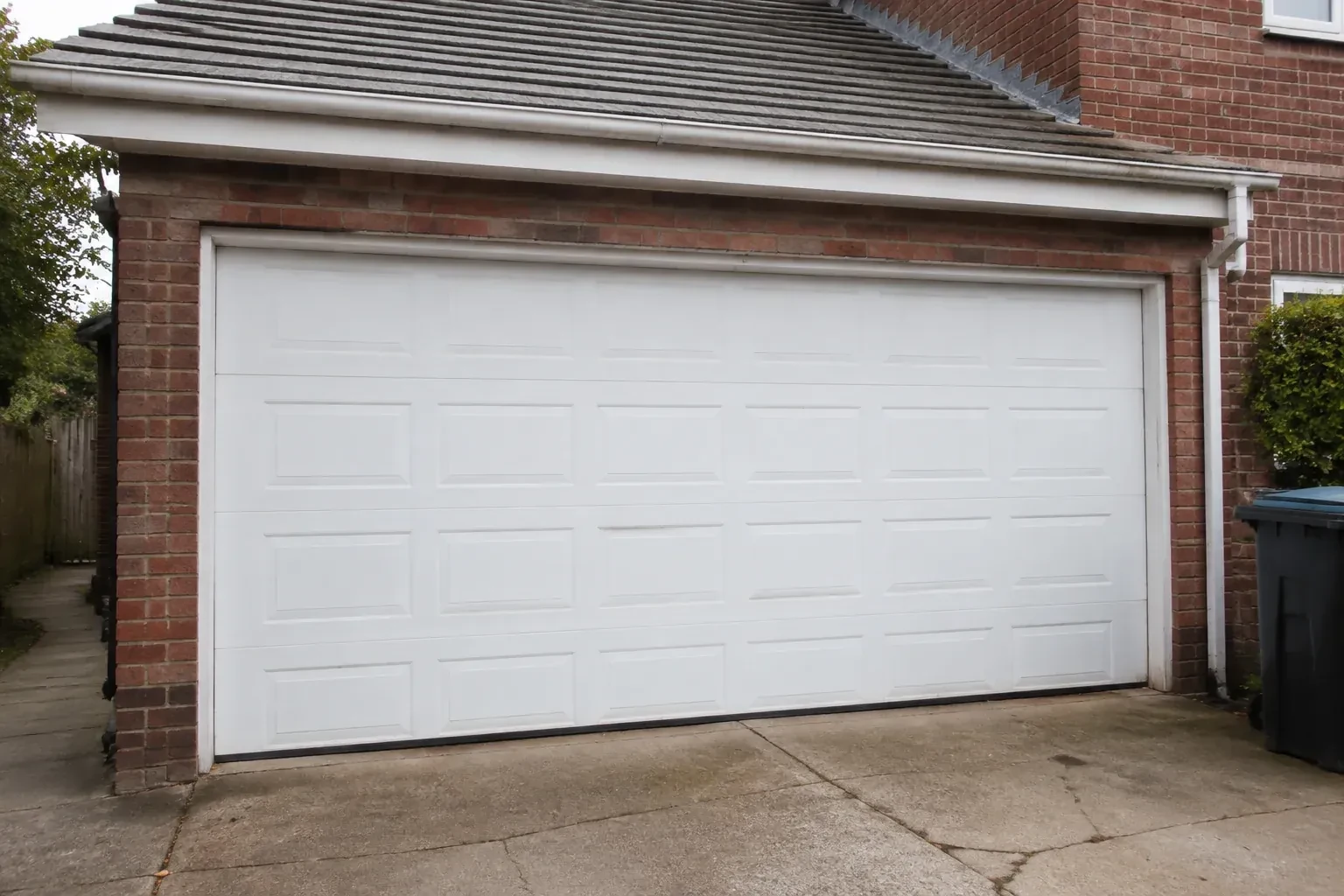
How should I clean the new exterior?
Follow the care information for the selected finish. In general, use a soft cloth or sponge with a suitable mild solution, rinse away residue and clear grime from the lower edge and seals. Road salt deserves regular attention during winter. Avoid abrasive methods unless the product guidance specifically says the surface accepts them.
What safety checks are done after installation?
The installer first checks manual balance, cable tracking, roller travel, track supports, fasteners and the fully open and closed positions. If an operator is connected, complete powered cycles follow. Photo-eye response, contact reversal according to the operator instructions, wall controls and emergency release are demonstrated. The customer also receives guidance on safe gripping points and keeping clear of section joints.
Does every wide double door need this replacement?
Width is an important factor because wind acts across the whole surface, but it is only one input. A sheltered low-rise opening and a broad exposed opening may have different project needs. The practical approach is to measure the door, review its existing reinforcement and documentation, and compare those facts with the criteria established for the building work.
Can a carriage-house door work with low headroom?
It often can, provided the available space is measured and a suitable track and spring arrangement exists for the selected door. Low-headroom layouts change how the top section turns and where hardware sits above the opening. Ceiling obstructions and opener geometry must be considered at the same time, so this condition belongs in the survey before the door configuration is ordered.
How do you measure for a glass garage door?
Measurements cover the opening width and height plus side room, headroom and backroom for the operating system. The check also records floor level, jamb plumb, header condition and ceiling obstructions such as lights, ducts or storage. Those dimensions guide the door size, track arrangement, spring location and operator position rather than serving as a simple panel measurement.
Can the finished door still be operated manually?
Yes. A properly counterbalanced sectional door is checked by hand, whether or not an electric operator is added. With powered equipment, a manual release disconnects the operator so the designated handle can be used; the door is closed first, since an open or unbalanced door can move unexpectedly once released. Handover includes a demonstration of disconnection, movement and reconnection under the product instructions. The release path and lifting area should remain accessible rather than being blocked by storage.
Why is the door lifting higher on one side?
Uneven travel commonly points to a lift-cable or drum issue, though a displaced roller, bent track or damaged bottom fixture can create a similar angle. The door is supported first, then both lifting sides are compared for cable condition, drum seating and hardware position. Correcting the cause and restoring equal tension brings the bottom edge back to level movement.
Can the closing limit be adjusted to stop a floor gap?
Limit adjustment is appropriate when the curtain, bottom bar and guides are aligned and the seal simply stops at the wrong point. A sloped sill, twisted bar, hardened astragal or shifted curtain needs its own correction first. Setting extra downward travel against a mechanical problem can compress the seal and load the operator without producing even contact.
What information helps assess feasibility from photos?
Useful photos show the full inside opening, both track sides, the wall above the header, the complete ceiling run, spring and shaft area, opener, beams, lights and other obstructions. Include a wider image showing the planned vehicle lift or equipment zone. Measurements remain necessary, but clear images help identify questions and prepare an efficient site assessment.